
Children’s Book Printing: A No-Nonsense Guide for Authors and Publishers
You wrote the story. You found the illustrator. Now comes the part nobody talks about enough actually getting it printed right.
Children’s book printing is trickier than people expect. Paper weight matters. Color accuracy matters. Even the way pages turn matters when your reader is four years old and prone to ripping things.
Let’s break it down properly.
Why Children’s Book Printing Services Are Different
Printing a novel and printing a picture book are not the same job. Not even close.
Children’s book printing services have to account for things regular book printers might not think twice about:
- Thicker, more durable paper that can survive sticky fingers
- Bright, accurate color reproduction for illustrations
- Rounded corners on some formats, for safety with younger kids
- Board book options for babies and toddlers
- Binding that holds up under repeated, rough handling
A regular paperback printer might do a fine job on a novel. Hand them a picture book with vibrant illustrations, and things can go sideways fast — colors shift, pages feel flimsy, or the binding just doesn’t last.
Children’s Book Printing: What Actually Goes Into It
There’s more to this than tossing a file at a printer and waiting.
Here’s roughly what the process looks like:
- File preparation — making sure illustrations are print-ready, high resolution, correct color mode
- Paper selection — weight, finish, and texture all get decided here
- Proofing — a physical or digital proof to catch errors before full production
- Printing — the actual run, whether it’s 50 copies or 5,000
- Binding and finishing — trimming, binding, sometimes lamination or spot UV
Skip any of these steps, or rush them, and it shows in the final product. Trust me, readers notice a blurry illustration or a spine that cracks after three reads.
Kids Book Printing: Choosing the Right Paper
This part trips up a lot of first-time authors.
Kids book printing paper choices usually fall into a few categories:
- Uncoated paper: Softer look, less glare, common in text-heavy books
- Matte coated: Good color without harsh shine
- Gloss coated: Bold, vibrant colors, popular for picture books with heavy illustration
- Board stock: Thick, sturdy, used mainly for baby and toddler board books
If your book leans heavily on illustrations bright skies, colorful characters, detailed backgrounds gloss or matte coated stock usually gives the best results. Text-heavy chapter books can often get away with simpler uncoated paper.
Picture Book Printing: Getting Colors Right
Here’s something a lot of authors don’t realize until it’s too late: what you see on your screen is not what comes out of the printer. Not automatically, anyway.
Picture book printing requires proper color calibration. Screens use RGB. Printers use CMYK. That mismatch can turn a bright, punchy illustration into something dull and washed out if nobody catches it early.
A few tips to avoid color disasters:
- Always request a physical proof before the full print run
- Convert files to CMYK before submitting, not after
- Ask your printer about their color matching process
- Don’t trust your monitor alone — calibrate it or compare against a printed sample
This one step alone saves so many headaches. Skipping it is asking for trouble.
Hardcover Children’s Book Printing: Is It Worth the Cost?
Hardcover costs more. That’s just a fact. But there are real reasons authors still choose it.
Hardcover children’s book printing offers:
- Better durability for repeated reading, especially with younger kids
- A more premium, gift-worthy feel great for holiday or birthday markets
- Often perceived as higher quality by parents and buyers
- Longer shelf life in libraries and schools, which matters if you’re targeting institutional sales
Paperback is cheaper and works fine for many self-published authors, especially those testing the market first. But if your book is aimed at gifting, libraries, or a premium price point, hardcover often makes more sense.
Custom Children’s Book Printing: What “Custom” Actually Means
People throw around the word “custom” a lot. Here’s what it actually covers.
Custom children’s book printing can include:
- Personalized trim sizes, not just standard 8×8 or 8.5×11
- Special finishes like foil stamping or embossing on covers
- Unique binding styles, including spiral or saddle-stitch for workbooks
- Custom paper stocks matched to a specific look or feel
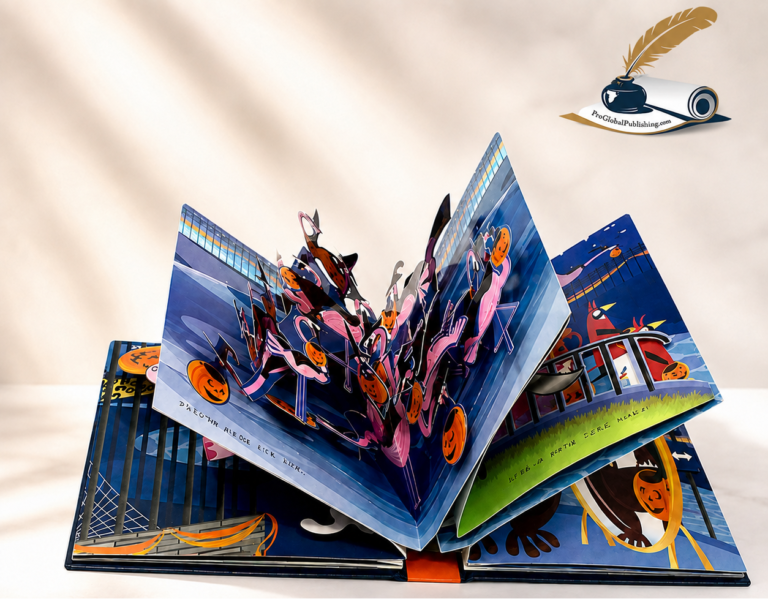
- Interactive elements like pop-ups, flaps, or texture pages
Custom work usually costs more and takes longer. But if your book has a unique format — say, a lift-the-flap design or an oversized coffee-table-style picture book — custom printing might be your only real option.
Choosing a Children’s Book Printing Company
Not all printers are created equal. Some genuinely specialize in kids’ books. Others just dabble.
Questions worth asking before committing to a children’s book printing:
- Do you have experience specifically with children’s or picture books?
- Can you show samples of similar past projects?
- What’s your minimum order quantity?
- Do you offer proofs before full production runs?
- What’s your typical turnaround time?
A printer that hesitates on any of these, or can’t show real samples, probably isn’t the right fit. Trust your gut here.
Color Children’s Book Printing: Small Details That Matter
Color children’s book printing lives or dies on the details. A few small things that make a bigger difference than people expect:
- Ink saturation levels, especially for dark or deep-toned illustrations
- Paper brightness, which affects how colors actually appear
- Consistency across the full print run, not just the first few copies
- Proper bleed settings so no white edges sneak in around illustrations
Ask your printer directly how they maintain consistency across a large run. A good answer here usually signals real experience.
Children’s Book Printing for Self Publishers: What to Know
Self-publishing changes the math quite a bit compared to going through a traditional publisher.
Children’s book printing for self publishers typically involves:
- Smaller print runs, sometimes print-on-demand instead of bulk orders
- More direct control over paper, size, and finishing choices
- Higher per-unit cost at low volumes, dropping as quantities increase
- More responsibility for quality control since there’s no publishing house double-checking things
Print-on-demand works well for testing a book before committing to a bigger run. Once you know it sells, bulk printing usually brings the per-copy cost down significantly.
How to Print Children’s Book Without Overspending
Budgets matter, especially for first-time authors. A few ways to keep costs reasonable without cutting corners that actually hurt the final product:
- Compare quotes from at least three printers before deciding
- Order proofs digitally when possible, saving physical proof costs for final approval only
- Choose standard trim sizes over custom ones when budget is tight
- Consider paperback first, hardcover later once demand is proven
None of this means going cheap on quality. It just means being smart about where the money actually goes.
Final Thoughts
Printing a children’s book is part art, part logistics. Get the paper right. Get the colors right. Pick a printer who actually understands kids’ books, not just books in general. Do that, and the final product will hold up literally and figuratively through years of bedtime reading.
Q: What’s the minimum order for kids book printing?
This depends heavily on the printer. Some offer print-on-demand with no minimum, while others require a minimum of 100 to 500 copies for bulk pricing.
Q: Is hardcover or paperback better for a children’s book?
Hardcover tends to hold up better for younger readers and feels more gift-worthy. Paperback is cheaper and works well for testing the market first.
Q: Do I need to convert my files to CMYK before printing?
Yes, generally. Files created in RGB often print with dulled or shifted colors. Converting to CMYK beforehand helps match what you see on screen.
Q: Can I get a physical proof before the full print run?
Most reputable children’s book printing companies offer this, and it’s strongly recommended before committing to a large order.
Q: What paper is best for picture book printing?
Gloss or matte coated paper usually works best for illustration-heavy books, giving colors more vibrancy compared to uncoated stock.
Q: Is custom children’s book printing more expensive?
Generally, yes. Custom trim sizes, special finishes, or interactive elements add to both cost and production time compared to standard formats.
Q: What’s the best option for self-published authors on a budget?
Print-on-demand is often the smartest starting point, letting authors test demand before investing in a larger bulk print run.
Q: How long does children’s book printing usually take?
It varies, but a typical timeline runs anywhere from two to six weeks, depending on print run size and whether custom finishing is involved.